Aventura Mall is a commercial destination. Tidal Cove requires a day pass that can run anywhere from $55 to $500 depending on the date you pick. Founders Park requires a resident membership card for free entry, and if you don't have one, there's a fee at the door. Turnberry Isle Country Club requires a membership application.
Then there is a paved loop that circles the golf course, and it wants nothing from you at all.
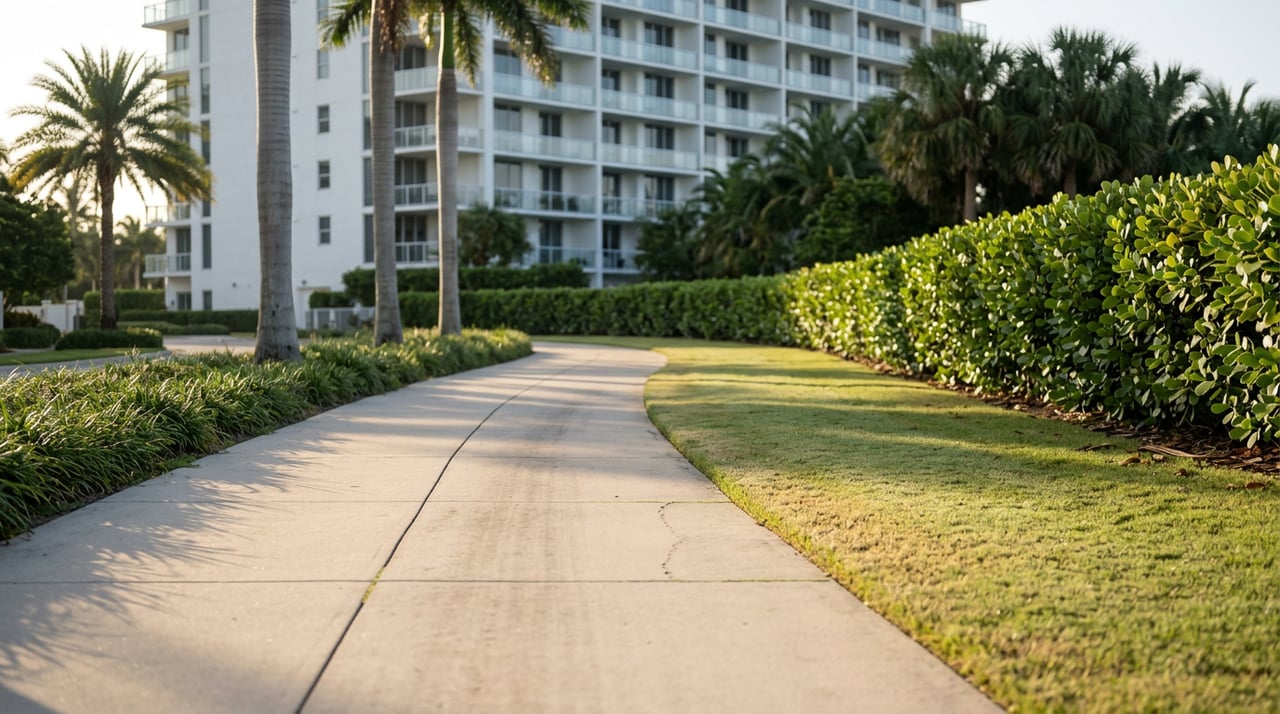
Residents call it the Circle. The city calls it the Don Soffer Exercise Trail. It is 3.1 miles of asphalt with no turnstile, no season, and no hours, open around the clock under its own lighting. Among Aventura's amenities, that public access is worth a closer look. Its story also connects to Aventura's founder.
Different Amenities, Different Access
Start with Tidal Cove, the water park tucked inside the JW Marriott Miami Turnberry Resort & Spa. It is a genuinely impressive five-acre setup with a 60-foot slide tower, a lazy river, and the country's first FlowRider Triple surf simulator, and hotel guests get two free passes a day built into their room. Everyone else pays. The park's own site lists day admission that swings from around $55 on a quiet weekday to as much as $500 depending on demand, and parking runs an extra $35 on top of that.
Founders Park, elsewhere in the city, runs on a different kind of gate. It is genuinely excellent for what it offers: a splash pad, four tennis courts, ball fields, playgrounds. It is fenced, and Aventura residents get in free with a membership card issued by the city. Visitors from outside Aventura pay a small entry fee.
Aventura Mall's open sidewalks and free parking make it easy to visit. It was voted Best Mall in the United States by USA Today's 10Best Readers' Choice Awards for the second year running in 2026.
Set the Circle next to those amenities and its public access stands out. No card, no day pass, no season pass, no proof of residency. You can start your loop at 5 a.m. or 11 p.m. and the trail doesn't know the difference.
Then There Is the Loop
The Circle wraps the Turnberry Isle Country Club golf course, and the routing is doing real work. It threads past the JW Marriott Turnberry, close enough to catch glimpses of Tidal Cove's slides and the âme Spa building, and it stays lit the entire way, which is why it functions less like a park amenity and more like a piece of civic infrastructure that happens to be shaped like a running loop.
Along the way you'll find:
- Water fountains spaced out across the 3.1 miles, so nobody's carrying a gallon jug for a sunrise loop
- Benches at regular intervals, useful for a phone call, a shoe re-lace, or just a break from the Florida heat
- Emergency call poles, a detail that says something about who this trail was actually built to serve
- Public restrooms, an amenity easy to take for granted until a trail doesn't have one
- Sightlines to the golf course itself, with the kind of open green space that high-rise living rarely offers up for free
The user mix tells its own story. Early mornings bring runners beating the heat. Mid-morning is stroller traffic and dog walkers, leash rule enforced, waste bags stocked and used. By evening it's cyclists, walkers working off dinner, and teenagers on skates who grew up calling it the Circle without ever knowing its official name. Nobody checks anybody's address.
Don Soffer and Aventura’s Golf-Course Plan
The trail's formal name is not a bureaucratic afterthought. It belongs to Donald Soffer, the developer who bought 785 acres of overlooked swampland north of Miami in 1967 for roughly $6 million and, according to his family, sketched the outline of the city he wanted to build on the back of a cocktail napkin. He named it Aventura, Spanish for adventure, and when the city formally incorporated in 1995, it kept the name he'd chosen decades earlier.
What makes the story relevant here is the shape of the plan itself. Soffer didn't just zone Aventura for towers and call it done. According to Turnberry's own account of his life, he master-planned the city around a golf course specifically to position residential buildings so they overlooked the greens and to build a sense of shared community into the physical layout from day one. The golf course wasn't an amenity bolted onto a finished development. It was the organizing idea. The eventual exercise trail circles that course and is open to the public.
Soffer died on July 20, 2025, at his home in Aventura, at 92. His family's statement afterward put it plainly.
"Don lived and breathed the community he created."
He was laid to rest near the 18th hole of the Turnberry Isle Country Club golf course, the same course the exercise trail circles today. It is not a detail most people walking the Circle on a Tuesday morning are thinking about. But the loop residents run for exercise, walk with their dogs, or push a stroller around at sunset shares its literal ground with Aventura's founder.
What That Means for the Morning You're Actually Having
None of this changes what the Circle feels like on an ordinary Saturday. It's still just a paved loop, still lined with palms and golf course views, still populated by the same mix of joggers and cyclists and parents pushing jogging strollers past the fountain at mile two. That's precisely the point. The trail asks nothing of you before you're allowed to use it: no pass or proof of residency.
If your loop ends the way a lot of residents' loops end, there's a reasonably new stop for it. Crema Gourmet opened its Aventura location this past spring, adding an all-day café option along Biscayne Boulevard that's become a natural place to land after a morning on the trail. It's a small addition, but it fits a pattern worth noticing: Aventura keeps adding polish around the edges of the neighborhood while the actual center of daily life, the loop itself, stays exactly as open as it was the day it opened.
That's the version of Aventura that doesn't show up in a mall directory or a water park price list. It's a public, no-cost way to experience the city beyond its mall and resort amenities.
If Aventura's mix of open trails, gated parks, and resort-scale amenities has you thinking more seriously about the neighborhood, or about how a move here compares to what you're used to further north, the Pitlake Group works this market and the New York corridor that feeds it every day. Schedule a private consultation when you're ready to talk specifics.