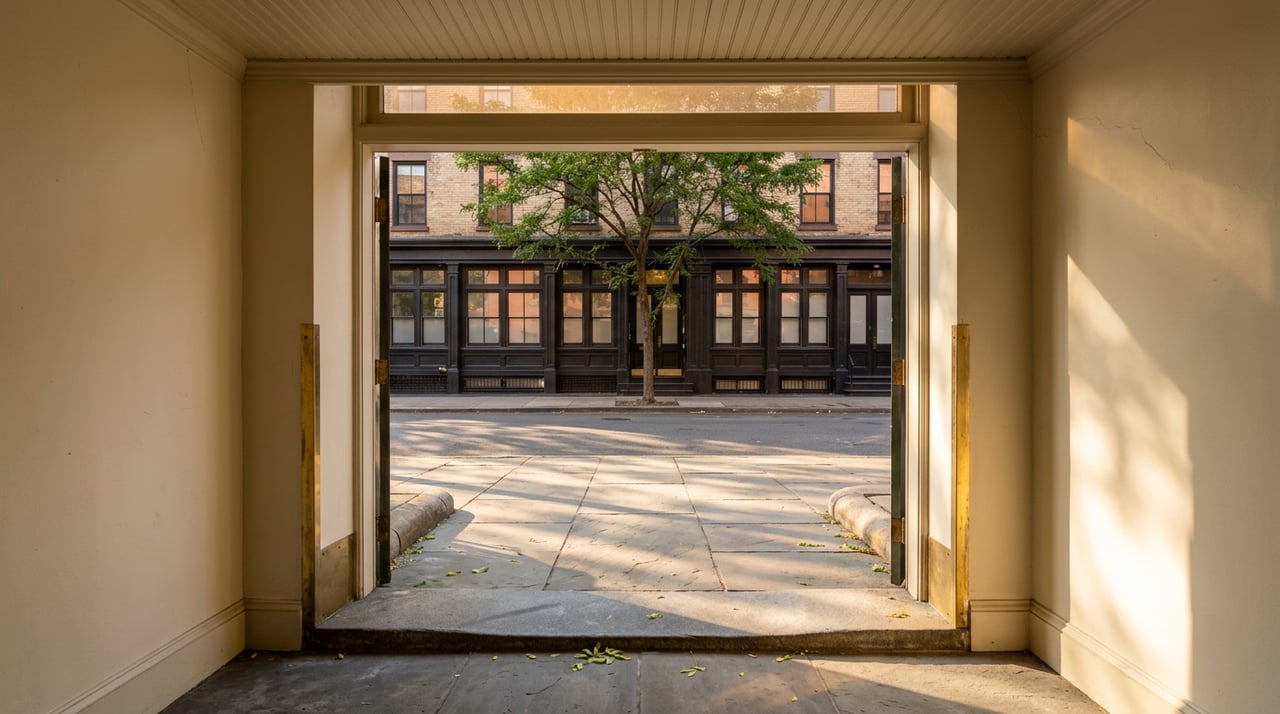
One Fifth Avenue, the building where Fifth Avenue meets Washington Square Park, has spent nearly a century collecting the middle chapters of other people's stories. In 1934 its ground floor opened as the #1 Bar, a supper club that helped launch performers like Dorothy Lamour and Paul Lynde before it settled into a long run as a steakhouse and piano bar. In 1970, restaurateur Patricia Murphy brought her Candlelight Restaurant concept there for its final New York location, a room of popovers and low light that lasted until rising costs closed it in the mid-1970s. Sometime in between, Robert Mapplethorpe and Patti Smith became regulars, and two brothers named Brian and Keith McNally worked the floor before either one had opened a restaurant of his own. Those are the same McNallys who later built Balthazar and Pastis, the places most New Yorkers now assume have always been there.
None of that happened because the building photographs well, though it does. It happened because One Fifth Avenue has a pattern of hosting concepts that already proved themselves somewhere else, arriving to write a second or third act rather than a first. This year the building picked up a new tenant that fits the pattern exactly, and it is not the only sign that the habit is spreading through the neighborhood around it.
An Address That Keeps Choosing Proven Acts
Golden Steer opened its doors in Las Vegas in 1958 and never left, becoming the city's longest continuously operating steakhouse and a regular stop for Frank Sinatra, Dean Martin, and Elvis. Sixty-eight years later, it finally expanded, and the only address it chose outside Nevada was One Fifth Avenue in Greenwich Village. Co-owners Nick McMillan and Amanda Signorelli brought in the design firm Modellus Novus, the same team behind Tatiana and Crown Shy, to build a room that leans on the original's mirrored ceilings, western-themed art, and tableside theater without simply copying it. Executive Chef Brendan Scott, who previously worked at Carne Mare and the late Montrachet, runs a kitchen built around wet-aged USDA Prime steaks, a tableside Caesar finished with real technique, and a Cherries Jubilee that arrives on fire. A twelve-ounce filet runs around $106; the chicken hunter style, stuffed with porcini and finished in a marsala reduction, is $42.
The space itself carries its own history into the deal. It previously housed both One Fifth and Otto, two restaurants that never quite found their footing there. Signorelli has described the project as treating the Village less as a new market to conquer and more as a second home for a concept that already knows what it is:
"We treated this as a bridge between Las Vegas and New York, staying true to Golden Steer in scale and indulgence with a New York seasonal point of view."
Two private rooms round out the space, the Mob Room and the Showgirl Room, the latter anchored by an original sequined headdress from a 1978 Las Vegas revue. Combined, they hold up to 34 guests for private events. The restaurant is open Tuesday through Saturday, 5 to 10 p.m., and enforces a dress code that rules out baseball caps and athleisure. Children under five are not permitted at all, and older kids are held to the same dress standard as adults.
Two Blocks Over, a Counter Graduates to a Room
Sendo built its reputation on the opposite end of the spectrum: a tight, counter-only sushi spot up a narrow staircase near Herald Square, where diners waited for a seat at a 300-square-foot room to get Tokyo-style nigiri and omakase sets at prices well under what most Manhattan sushi counters charge. That original location earned a devoted following, including a high-profile pop-up with a visiting Tokyo chef, entirely on the strength of quality-per-dollar rather than square footage.
This spring, Sendo filed plans for a second location at 43 West 8th Street, on the corner of Sixth Avenue, a few blocks west of One Fifth. The new space runs 900 square feet across a second floor, with 29 total seats split between 14 at tables and 15 at a bar that now pours beer and wine, a first for the brand. It opened May 12, 2026, with the same Hokkaido rice and Toyosu Market fish the original built its name on, alongside signature sets like the Hokkaido (ten nigiri, two hand rolls, one kaisendon) and the Sendo Don, layered with toro, seabass, ikura, scallop, shrimp, and uni. Omakase sets start around $34. The room itself trades the original's tight quarters for cherry and walnut wood tones, polished gray marble counters, and wallpaper drawing on Edo-era motifs.
Across the Park, a Miami Hit Finds Its Second New York Address
Motek arrived in New York with a following already built. Founded by restaurateur Charlie Levy, the Mediterranean and Israeli concept became a fixture across South Florida, with locations in Brickell, South Beach, and Coral Gables, before making its first New York move into Flatiron in September 2025. Seven months later, in early April 2026, it opened a second Manhattan location at 184 Bleecker Street, on the corner of MacDougal, with large windowed doors that fold open in warmer months to turn the corner into an indoor-outdoor room. The Bleecker location seats about 120 inside and another 50 on an outdoor patio, considerably larger than a typical storefront on that stretch, and runs all-day dining from brunch through dinner with a $5 happy hour every day of the week.
The Pattern in One Table
Three concepts, three different cuisines, three separate addresses within a ten-minute walk of Washington Square Park, all landing between January and May of this year. None of them is a first restaurant for the people behind it.
| Restaurant | Proven Elsewhere | Village Address | Opened | Starting Point |
|---|---|---|---|---|
| Golden Steer at One Fifth | Las Vegas, since 1958 | 1 Fifth Avenue | Early 2026 | Prime steaks from around $106 |
| Sendo | Original counter near Herald Square | 43 West 8th Street | May 12, 2026 | Omakase sets from $34 |
| Motek | Miami, then Flatiron (Sept 2025) | 184 Bleecker Street | April 2026 | $5 daily happy hour |
What the Clustering Actually Tells a Resident
A restaurant scene built on first-timers behaves differently than one built on transplants. First-timers are testing an idea, which means menus shift, hours change, and half the appeal is watching a concept find its footing in real time. What landed in the Village this year is the opposite. Golden Steer had 68 years to work out its format before it ever left Nevada. Sendo had already proven its sourcing and pricing model at a fraction of this size. Motek had two cities and a full Flatiron year behind it before it picked Bleecker and MacDougal for round two.
That matters for anyone deciding where to spend a Friday night. A first-time concept asks you to be patient while it figures itself out. A concept on its second or third address is already dialed in, which means what you get on opening week is close to what you'll get a year from now. The risk of a rough patch is mostly already retired somewhere else.
It also says something about how these operators read the neighborhood itself. None of them needed the Village. Golden Steer could have picked Midtown or the Meatpacking District for the visibility. Sendo could have expanded within its own established radius. Motek's usual growth pattern runs through South Florida and outer boroughs, not necessarily a six-figure Bleecker Street lease. Each one chose the Village anyway, on a block that already has a track record of the same thing happening to other people's restaurants for the better part of a century.
A Short List for the Next Few Weeks
If you are deciding where to actually use this information, a few practical notes worth knowing before you go. Golden Steer requires reservations for the dining room, though the bar seats first-come, first-served with access to the full menu, and the entire party needs to be present before you're seated. Sendo's new room takes both walk-ins at the bar and reservations for tables, a shift from the original counter's line-up-and-wait model. Motek runs happy hour daily and keeps its patio doors open through the warmer months, which makes it the most flexible of the three for a spontaneous plan rather than a reservation you booked two weeks out.
None of this changes what Greenwich Village has been for decades: a small footprint with an outsized appetite for hosting somebody else's second chapter. This year it just happened to host three at once.
The Pitlake Group keeps close watch on how a neighborhood's daily rhythm changes block by block, whether that shows up in a new restaurant lease or a shift in what a landmark building attracts next. If you're weighing what a move into or within Greenwich Village might look like down the road, we're glad to talk through what we're seeing on the ground. Schedule a Private Consultation whenever you're ready.